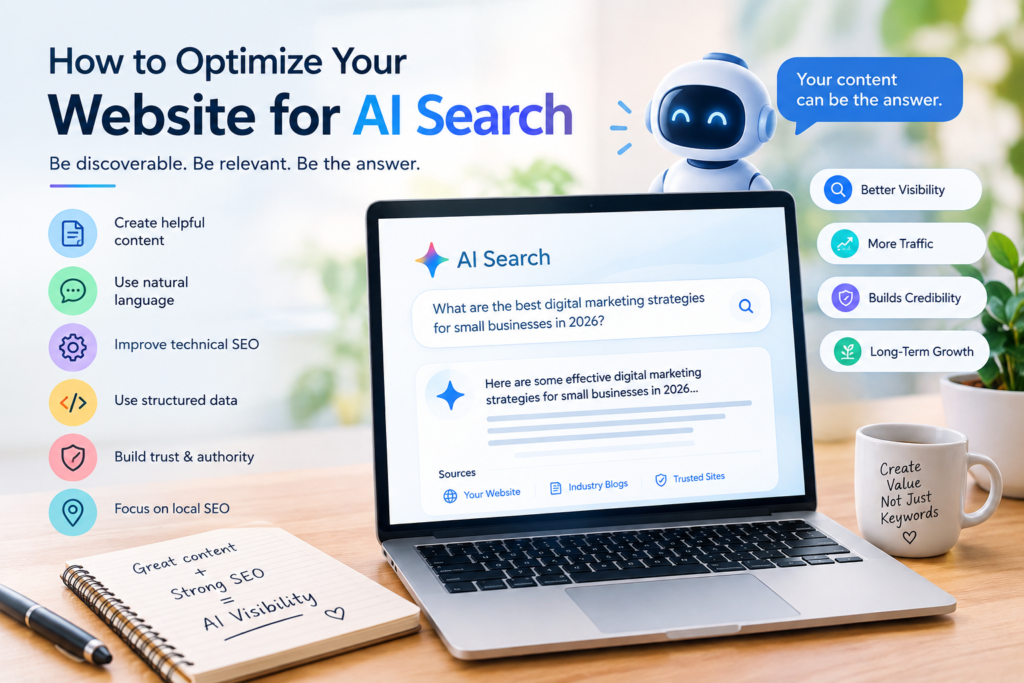
Search is changing rapidly. People are no longer relying only on traditional search engines to find information. AI-powered search experiences such as Google’s AI features, ChatGPT, Microsoft Copilot, and other AI assistants are changing how users discover websites, businesses, products, and services.
This shift creates a new opportunity for businesses and digital marketers. Instead of optimizing a website only for traditional search engine rankings, businesses should also make their content easy for AI systems to understand, extract, and reference.
So, how can you optimize your website for AI search? Let’s explore the key strategies.
What Is AI Search?
AI search uses artificial intelligence to understand a user’s question and provide a more detailed, conversational answer. Instead of simply displaying a list of links, AI-powered search can summarize information from multiple sources and provide users with direct answers.
For example, instead of searching for “best digital marketing strategies,” a user might ask an AI search tool:
“What digital marketing strategies should a small business use to get more customers in 2026?”
AI systems try to understand the meaning and intent behind the question. This makes clear, useful, trustworthy website content more important than ever.
1. Create Helpful and High-Quality Content
The foundation of AI search optimization is valuable content.
AI systems need reliable information that directly answers users’ questions. Your content should therefore focus on solving problems rather than simply adding keywords to a page.
Create content that:
- Answers common customer questions
- Provides practical solutions
- Explains complicated topics clearly
- Includes examples and useful information
- Matches the search intent of your audience
- Is regularly reviewed and updated
For example, if you provide digital marketing services, don’t create a page that only says “We offer SEO services.” Instead, explain what SEO is, why businesses need it, what your process involves, and what customers can expect.
2. Use Natural, Conversational Language
AI search understands context and meaning, not just individual keywords.
This means your content should sound natural and answer questions in the way people actually ask them.
Instead of repeatedly using a keyword such as “digital marketing services in Kochi,” create useful sentences around related questions:
“What are the benefits of digital marketing for businesses in Kochi?”
“How can a small business improve its online visibility?”
“What digital marketing services does a growing business need?”
Using natural language helps search systems understand the topic and context of your content.
3. Answer Questions Directly
Question-based content can be particularly useful for AI search.
Think about the questions your customers are likely to ask and provide direct answers.
For example:
What is SEO?
SEO, or Search Engine Optimization, is the process of improving a website’s visibility in organic search results by optimizing its content, structure, technical performance, and relevance.
Keep important answers clear and concise before providing additional details. This makes your content easier for both users and search systems to understand.
Adding FAQ sections to relevant pages can also help you address multiple customer questions in one place.
4. Build Strong Topic Authority
AI search doesn’t only look at individual keywords. Understanding the overall topic and context of a website is important.
Instead of publishing one article about SEO, create a collection of useful content around the subject.
For example, an SEO content cluster could include:
- What is SEO?
- How does SEO work?
- On-page SEO techniques
- Technical SEO basics
- Keyword research guide
- Local SEO strategies
- SEO mistakes to avoid
- How to measure SEO performance
Link these related articles together using relevant internal links. This creates a stronger content structure and helps users and search systems discover related information.
5. Improve Your Website’s Technical SEO
Good content alone isn’t enough. Your website should also be technically accessible and easy to understand.
Important technical SEO factors include:
- Fast page loading speed
- Mobile-friendly design
- Secure HTTPS connection
- Clear website navigation
- Descriptive page titles
- Proper heading structure
- Search-engine-friendly URLs
- Optimized images
- Internal linking
- Structured data where appropriate
A technically healthy website makes it easier for search engines and AI systems to access and interpret your content.
6. Use Structured Data
Structured data provides additional information about the content of a webpage in a machine-readable format.
Depending on your website, you may use relevant structured data for things such as:
- Articles
- Products
- Organizations
- Local businesses
- Events
- Reviews
- Frequently asked questions
Structured data doesn’t guarantee that your content will appear in an AI-generated answer. However, accurate markup can help search systems better understand the entities and information presented on your pages.
7. Demonstrate Experience and Trust
AI search makes trustworthy information increasingly important.
Show visitors why they should trust your business and your content.
You can strengthen credibility by including:
- Author information
- Business details
- Contact information
- Real examples and case studies
- Original research or insights
- References to reliable sources
- Customer reviews where appropriate
- Clear information about your products or services
Avoid publishing generic AI-generated articles without reviewing them. Human expertise, accuracy, originality, and useful insights can make your content more valuable.
8. Focus on Local SEO
For businesses serving a specific location, local SEO remains important.
Make sure your website clearly communicates:
- Business name
- Location
- Services
- Contact information
- Areas served
- Opening hours where relevant
Create useful location-specific content rather than simply repeating a city name throughout your website.
For example, a digital marketing professional serving Kochi could publish content about digital marketing challenges faced by local businesses, local SEO strategies, and online marketing opportunities for businesses in the area.
9. Keep Your Content Fresh
AI search is constantly evolving, and outdated information can become less useful over time.
Review important pages regularly and update:
- Statistics
- Industry trends
- Examples
- Links
- Product or service information
- Screenshots
- Dates and references
Updating old content can also provide an opportunity to improve its structure, clarity, and usefulness.
10. Think Beyond Traditional Rankings
AI search optimization is not simply about achieving a higher position in a traditional search results page.
Your goal should be to become a useful and trustworthy source of information.
Create content that can answer questions, explain concepts, provide original insights, and demonstrate genuine expertise.
Think about the entire customer journey. Someone might first discover your brand through an AI-generated answer, then visit your website, read your blog, explore your services, and eventually contact you.
Conclusion
AI search is changing how people discover information online. Businesses that want to remain visible need to think beyond traditional keyword optimization.
The most effective approach is to create helpful, accurate, well-structured, and trustworthy content while maintaining strong technical SEO. Answer customer questions directly, build topical authority, use structured data where appropriate, strengthen local SEO, and keep your website updated.
Most importantly, don’t create content only for search engines or AI systems. Create content that genuinely helps people. When your website provides clear answers and real value, it becomes a stronger resource for both users and modern search technologies.
AI search is still evolving, but one principle remains important: useful content, strong website fundamentals, and genuine expertise are the foundation of long-term digital visibility.