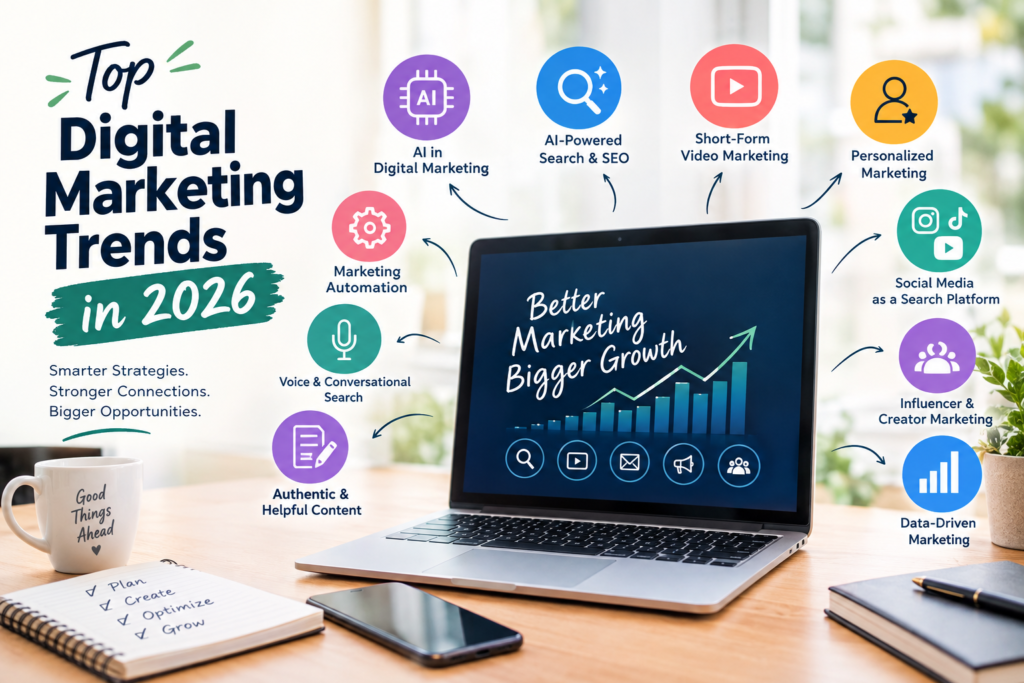
Digital marketing is constantly changing as technology, consumer behavior, and online platforms continue to evolve. In 2026, businesses are using smarter technologies, personalized content, automation, and data-driven strategies to connect with their audiences. For brands that want to remain competitive, understanding the latest digital marketing trends is more important than ever.
From artificial intelligence and AI-powered search to short-form videos and personalized customer experiences, digital marketing in 2026 is becoming more intelligent and customer-focused. Let’s explore the top digital marketing trends businesses should know this year.
1. Artificial Intelligence in Digital Marketing
Artificial intelligence (AI) is one of the biggest trends shaping digital marketing in 2026. AI tools are helping marketers with content creation, customer research, data analysis, advertising, email marketing, and campaign optimization.
Marketers can use AI to generate content ideas, analyze customer behavior, identify trends, create personalized messages, and automate repetitive tasks. AI can save time and help marketing teams make faster, data-informed decisions.
However, AI does not replace the need for human creativity. Businesses still need original ideas, authentic communication, and human oversight to create content that customers can trust.
2. AI-Powered Search and the Future of SEO
Search behavior is changing rapidly. People are increasingly using AI-powered search experiences to find answers instead of relying only on traditional search results.
This has created new opportunities for marketers to optimize content for AI-driven search. Businesses need to focus on creating useful, accurate, well-structured content that clearly answers users’ questions.
Traditional SEO remains important, but marketers are also paying attention to concepts such as Answer Engine Optimization (AEO) and Generative Engine Optimization (GEO). The goal is to make content easy for both people and modern search systems to understand.
3. Short-Form Video Marketing
Short-form videos continue to be an important part of digital marketing. Platforms such as Instagram Reels, YouTube Shorts, and other video-based channels allow businesses to communicate their message quickly and creatively.
Short videos can be used for product demonstrations, educational content, customer testimonials, behind-the-scenes videos, tips, and brand storytelling.
For small businesses, short-form video is particularly useful because engaging content can be created without requiring a large production budget. The key is to provide value quickly and maintain a consistent publishing strategy.
4. Personalized Marketing
Customers expect brands to understand their interests and provide relevant experiences. This is why personalization is becoming increasingly important in 2026.
Businesses can personalize email campaigns, website experiences, product recommendations, advertisements, and social media communication based on customer interests and interactions.
For example, an online store can recommend products based on previous browsing behavior. Similarly, an email campaign can provide different content to customers depending on their interests.
Effective personalization can make marketing communication more relevant while helping businesses build stronger relationships with their audiences.
5. Social Media as a Search Platform
Social media is no longer used only for entertainment and communication. Many users now search social platforms for products, services, recommendations, tutorials, restaurants, businesses, and reviews.
This means businesses need to think beyond traditional social media posting. Profiles should contain relevant information, useful keywords, and clear descriptions.
Creating searchable social media content can help businesses reach people who are actively looking for information, products, or services.
6. Influencer and Creator Marketing
Influencer marketing continues to evolve in 2026. Instead of focusing only on celebrities with huge audiences, brands are increasingly interested in creators who have specific communities and strong audience relationships.
Micro-influencers and niche creators can provide businesses with access to highly relevant audiences. Their content can also feel more authentic and relatable.
For businesses, choosing a creator should involve more than looking at follower numbers. Audience relevance, engagement, content quality, credibility, and brand alignment are important factors to consider.
7. Data-Driven Marketing
Data remains an important part of successful digital marketing. Businesses can use analytics to understand website traffic, customer behavior, campaign performance, conversions, and audience engagement.
Instead of making decisions based only on assumptions, marketers can use data to identify what is working and what needs improvement.
In 2026, marketers need to pay attention to meaningful metrics rather than focusing only on likes and followers. Metrics such as conversion rate, customer acquisition cost, engagement, leads, and return on investment can provide more useful insights.
8. Marketing Automation
Marketing automation helps businesses manage repetitive marketing activities efficiently. Automated systems can be used for email campaigns, lead nurturing, customer follow-ups, social media workflows, and other tasks.
For example, when someone signs up for a newsletter, an automated email sequence can introduce the business and provide useful information over several days.
Automation allows marketers to save time while maintaining consistent communication with customers. However, automated communication should still feel useful and relevant rather than overly repetitive.
9. Voice and Conversational Search
People are increasingly comfortable using conversational interfaces to ask questions and find information. This creates opportunities for businesses to create content that matches natural, conversational search queries.
Instead of focusing only on short keywords, marketers should consider the questions customers are actually asking.
Creating FAQ sections, detailed guides, and conversational content can help businesses address these search behaviors while providing useful information to their audiences.
10. Authentic and Helpful Content
Despite the growth of AI and automation, authentic content remains extremely important. Customers want useful information rather than content created simply to attract clicks.
Businesses should focus on demonstrating knowledge, answering real customer questions, sharing practical solutions, and providing original insights.
High-quality content can support SEO, build credibility, generate leads, and strengthen long-term relationships with customers.
Conclusion
Digital marketing in 2026 is being shaped by artificial intelligence, AI-powered search, short-form video, personalization, social media search, creator marketing, data analytics, automation, and authentic content.
The most important lesson for businesses is that technology should support customer-focused marketing rather than replace it. Businesses that understand their audience, create useful content, analyze performance, and adapt to changing digital behavior can build stronger online visibility.
Digital marketing is not about following every new trend blindly. It is about identifying the strategies that are relevant to your business and using them effectively. As digital platforms continue to evolve, marketers who keep learning and experimenting will be better prepared for the future.